
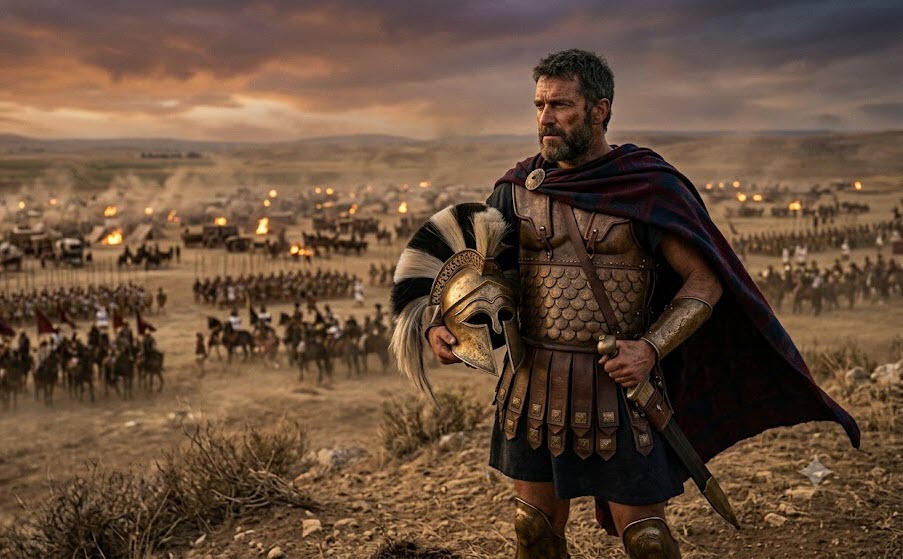
Admetus and Nicanor
Άδμητος και Νικάνωρ
Iakovos Garivaldis OAM
Two of the most trusted and capable commanders in Alexander the Great’s army marching to the East. In a series of examining Alexander the Great’s Expedition to the little known world of the East at the time, we will examine the commanders that stood by their king and assisted him greatly in his campaign.
The two commanders we want to examine here have really given their lives for their leader.
ADMETUS
Admetus (The ancient Greek word Άδμητος means “untamed” or “unbroken”) was a phenomenal soldier, and leaving him out misses a crucial tier of Alexander’s military: the frontline elite tactical commanders.
Admetus held the highly prestigious rank of commander of the Agema (Άγημα – the elite royal squadron) of the Hypaspists (Υπασπιστές, shield-bearing guards). These men weren’t just strategists sitting in the back; they were “first over the wall” leaders who possessed incredible physical strength and tactical bravery. Admetus was famously the very first Macedonian to breach the battlements during the climactic assault at the Siege of Tyre (332 BCE), where he was immediately killed by a spear after clearing the way for his men.
To capture commanders of Admetus’s specific calibre—those leading elite frontline regiments, vanguard units, or specialized shock troops—here is an expanded list of these crucial tactical leaders.
Elite Guards & Frontline Vanguard Commanders
The Hypaspist Officers (Admetus’s Peers)
Admetus: Commander of the Agema (Royal Squadron) of the Hypaspists. He led the amphibious breach at Tyre from the front lines and died on the city walls.
Aside from his famous death at Tyre, historical records (primarily Arrian’s Anabasis of Alexander) provide a few more specific details about Admetus of Macedon:
Military Rank and Command
Admetus held a highly prestigious position in the Macedonian army. He was the commander of the agema of the hypaspists (shield-bearers).
The hypaspists were an elite corps of foot guards, and the agema was the premier, first battalion of that unit. This meant Admetus and his men were responsible for guarding the King on foot and were deployed whenever a mission required maximum speed, agility, and lethal force—such as mountain warfare, rapid night marches, or breaching fortifications.
The Siege of Tyre (332 BC)
His definitive historical moment occurred during the brutal, seven-month siege of the island city of Tyre. When Alexander’s engineers successfully brought up the specialized ship-borne siege towers to the city walls, Alexander called for a general assault and selected Admetus’s elite unit to lead the breach.
Leading from the Front: As the gangplanks dropped from the siege ships onto the Tyrian walls, Admetus was the very first man to charge across and establish a foothold.
The Final Stand: Arrian records that Admetus was actively cheering on his men and urging them to push forward onto the rampart when he was struck and killed by a spear.
Legacy
Because he died at the front lines so early in the eastern campaign, he did not live to become one of the Diadochi or διάδοχοι (Alexander’s successor generals) who carved up the empire. However, Alexander held him in extremely high regard; following the fall of Tyre, the King honored Admetus and the other fallen soldiers with a massive military funeral, sacrifices, and athletic games to celebrate their sacrifice.
NICANOR
Nicanor (τhe ancient Greek name Νικάνωρ translates to “victor” or conqueror”). It is a compound of two primary Greek words : Νίκη (nikē): Meaning “victory” and Ἀνήρ (anēr): Meaning “man”, in the genitive case, andros ανδρός) – He was the overall commander (Archon) of the three Hypaspist battalions from the start of the campaign until his illness and death in 330 BCE.
Nicanor the son of the legendary general Parmenion and brother of Philotas, was one of the most capable and highly trusted military commanders in Alexander the Great’s army during the early years of the Asian campaign. Unlike many who lived to fight in the Wars of the Successors, Nicanor’s story is defined by a brilliant, unbroken streak of battlefield success cut short by sudden illness—just before his family met a tragic end.
Here is a breakdown of his life and critical contributions:
Commander of the Hypaspists
While Admetus of Macedon commanded the agema (the elite first battalion) of the hypaspists, Nicanor was the supreme commander of the entire hypaspist corps (roughly 3,000 elite infantrymen).
Because the hypaspists acted as the tactical bridge between the heavy phalanx and the rapid companion cavalry, Nicanor was constantly tasked with the most demanding assignments on the battlefield. Under his leadership, this unit became Alexander’s ultimate tool for rapid deployment, siege breaches, and flanking maneuvers.
Major Campaign Contributions
Nicanor played a pivotal role in every major set-piece battle of the campaign up until 330 BC:
Battle of the Granicus (334 BC): He successfully led the hypaspists on the right wing of the Macedonian line, protecting Alexander’s flank as the King made his daring cavalry charge across the river.
Siege of Miletus (334 BC): He was given command of the Macedonian fleet, executing a critical naval blockade that prevented the far superior Persian fleet from entering the harbor or relieving the city.
Battle of Issus (333 BC) & Battle of Gaugamela (331 BC): In both massive clashes against Darius III, Nicanor commanded the elite foot guards on the crucial right flank. His ability to keep pace with Alexander’s aggressive cavalry charges while maintaining a solid infantry line was essential to preventing the Macedonian army from being split open.
The Pursuit of Darius and Death
Following the victory at Gaugamela, Nicanor accompanied Alexander in the relentless, high-speed pursuit of Darius III into the eastern provinces (modern-day Iran).
In 330 BC, while marching through the region of Aria, Nicanor suddenly fell ill and died.
 Save as PDF