
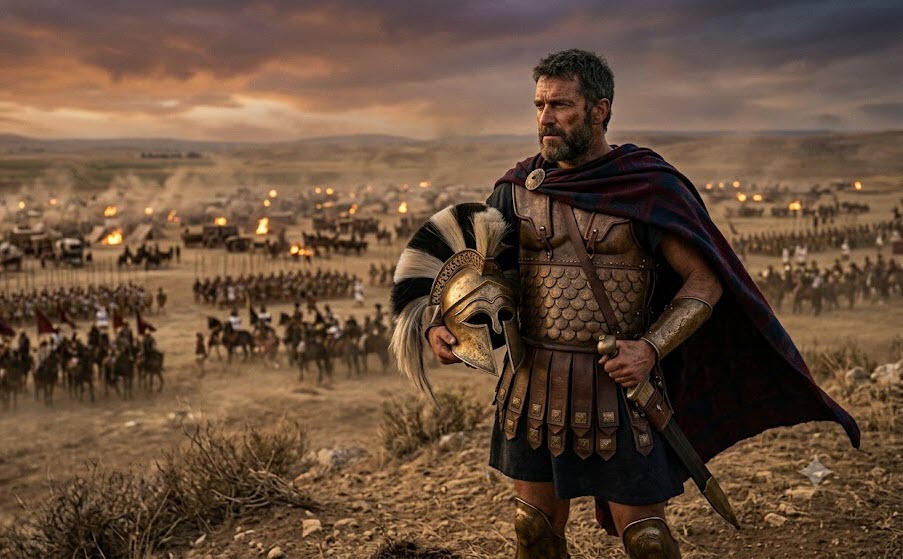
Seleucus and Neoptolemus
Continuing with Alexander the Great’s commanders we examine the lives of two new men. The stories of Seleucus and Neoptolemus (Σελεύκιος and Νεοπτόλεμος) represent two vastly different paths taken by the officers who served under Alexander the Great. One went on to forge the largest empire of the Hellenistic age, while the other fell early to betrayal and a bloody duel.
Seleucus I Nicator (Son of Antiochus)
- Life: c. 358 BCE – 281 BCE
- Key Role under Alexander: Commander of the elite Hypaspists (Shield-Bearers)
Early Life and Alexander’s Campaigns
Seleucus was the son of Antiochus, a distinguished general who served under Alexander’s father, Philip II of Macedon. As a noble youth, Seleucus was educated at the royal court as a page.
When Alexander launched his Asian campaign in 334 BCE, Seleucus accompanied him. He rose steadily through the ranks and, by the time the army reached India in 326 BCE, he was given command of the Hypaspists—the elite royal infantry that bridged the gap between the heavy phalanx and the Companion cavalry. He distinguished himself brilliantly against King Porus at the Battle of the Hydaspes.
The Wars of the Diadochi (successors) and Rise to Empire
Following Alexander’s death in 323 BCE, Seleucus initially served as an aide to the supreme regent, Perdiccas. However, when Perdiccas’s campaign into Egypt turned into a disaster, Seleucus joined a conspiracy to assassinate him in 321 BCE.
During the subsequent reshuffling of the empire (the Partition of Triparadisus), Seleucus was rewarded with the Satrapy of Babylon. He briefly lost it to his rival Antigonus the One-Eyed and fled to Egypt, but returned in 312 BCE to reclaim Babylon. This year marks the official founding of the Seleucid Empire.
Later Reign and Legacy
Seleucus expanded his borders eastward all the way to the Indus River, eventually securing a peace treaty with the Indian Emperor Chandragupta Maurya (trading eastern territories for 500 formidable war elephants). He used these elephants to crushing effect at the Battle of Ipsus (301 BCE), where he and his allies finally killed Antigonus.
At its height, the Seleucid Empire stretched from Thrace to the borders of India. In 281 BCE, after defeating his last great rival Lysimachus at the Battle of Corupedium, the 81-year-old Seleucus was on the verge of claiming the throne of Macedonia itself. However, as he crossed into Europe, he was abruptly assassinated by Ptolemy Ceraunus. He remains one of Alexander’s most successful and enduring successors.
Neoptolemus (νέος + πτόλεμος)
- Life: Died 321 BCE
- Key Role under Alexander: Officer in the Royal Guards (Hetairoi=those next to the king)
Service under Alexander
Neoptolemus (ancient greek etymology “meaning new to battle”) belonged to the Aeacidae house, making him a nobleman likely related to the royal family of Epirus (and thus a relative of Alexander’s mother, Olympias).
He was a physically powerful and aggressive soldier who served in the Companion cavalry and royal guards. His absolute finest hour came during the grueling Siege of Gaza (332 BCE), where Neoptolemus achieved great glory by being the very first Macedonian soldier to scale the city walls. While he was highly respected for his raw bravery, he developed a reputation for being arrogant, restless, and politically volatile.
Betrayal and the Fatal Duel
After Alexander died, Neoptolemus was managed with extreme suspicion by the regent Perdiccas, who sent him to campaign in Armenia. In 321 BCE, when Perdiccas marched on Egypt, he placed Neoptolemus under the watchful eye of Eumenes of Cardia.
Neoptolemus, deeply resentful of taking orders from Eumenes (who was a Greek secretary rather than a born Macedonian nobleman), immediately began secretly plotting with rival Macedonian generals Antipater (Αντίπατρος = αντί + πατρός) and Craterus (Κρατερός = ισχυρός/powerful). When Eumenes ordered him to bring his troops forward, Neoptolemus openly rebelled.
Eumenes reacted instantly, marching on Neoptolemus and routing his forces. Neoptolemus escaped with a small group of cavalry and fled to Craterus, convincing him to launch a surprise counter-attack. The two armies met at the Battle of the Hellespont (321 BCE / Hellespont = Hellene’s + Pontos=sea). During the chaos of the battle, Eumenes and Neoptolemus spotted each other across the field. Driven by intense personal hatred, they engaged in a brutal single combat on horseback. Both fell from their mounts, and after a desperate, bloody struggle on the ground, Eumenes managed to slay Neoptolemus, ending the rebellious commander’s life and ambitions.
Subscribe to our Newsletter
 Save as PDF