
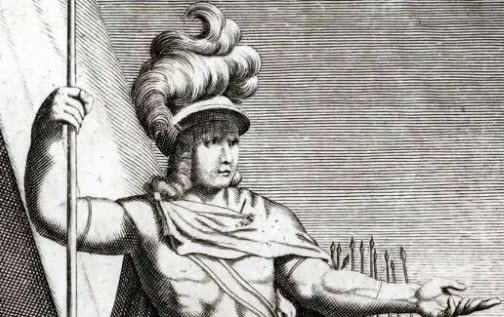
Eumenes, Peucestas, Balacrus
Three Men Behind the Throne:
Eumenes, Peucestas, and Balacrus in Alexander’s Asia
Alexander’s Asian campaign is remembered for the men at its center — Alexander himself, his generals Ptolemy and Nearchus, the philosopher-soldiers like Onesicritus. But the machine that actually ran the empire, administered its provinces, and occasionally saved the king’s life, was staffed by figures who rarely get top billing. Three of them — a Greek secretary who became a general, a bodyguard who became a satrap, and an officer who governed a province he never quite pacified — trace between them almost the entire shape of what Alexander’s conquest actually required: paperwork, courage, and administration.
Eumenes of Cardia — The Secretary Who Became a General
Eumenes of Cardia was a Greek general and scholar who came to Alexander’s court by an unusual route. At a very early age he was employed as private secretary by Philip II of Macedon, and after Philip’s assassination in 336 BC, by Alexander himself, whom he accompanied into Asia. In 330 he became Alexander’s principal secretary and keeper of the Royal Journal, making him one of the king’s closest associates — but as an administrator, not a soldier.
That changed as the campaign wore on. Alexander recognized Eumenes’s capability and eventually gave him command of troops, including a post as a cavalry commander in the eastern Punjab. It was a startling elevation for a Greek civilian in an army built almost entirely around Macedonian aristocracy, and it made him plenty of enemies — Eumenes was hated and despised by many fellow commanders, partly for his successes and partly, it’s said, for his Greek origins and his background as a mere scribe.
The truly remarkable chapter of his life came after Alexander died in 323 BC. In the chaotic division of the empire, Eumenes was made satrap of Cappadocia and Paphlagonia — territory that wasn’t even fully conquered yet — and spent the rest of his life fighting, with real skill, for the idea of a unified empire under Alexander’s legitimate heirs, at a time when nearly every other general was carving out a personal kingdom. He defeated the formidable Craterus at the Battle of the Hellespont in 321 BC, but was ultimately betrayed by his own veteran troops — the famed Silver Shields — and executed by his rival Antigonus in the winter of 316–315 BC.
Etymology: Εὐμένης (Eumenēs) derives from the Greek adjective εὐμενής, meaning “well-disposed, gracious, kindly” — itself built from εὖ (“good, well”) and μένος (“spirit, strength, passion”). The name essentially means “of good spirit” or “kindly-minded.” Given how much of Eumenes’s career was spent trying, against the odds, to hold Alexander’s fractured empire together for its rightful heirs, the “well-disposed” sense reads almost like a mission statement.
Peucestas — The Bodyguard Who Learned Persian
Peucestas’s moment of fame came in a single, violent afternoon. During the assault on a Mallian town (near modern Multan, in the Punjab) in 325 BC, Alexander was struck by an arrow and collapsed, seriously wounded, cut off inside the enemy town with only a handful of companions. Peucestas, along with Leonnatus and Abreas, fought to protect the fallen king, shielding him with the sacred shield Alexander had taken from the temple of Athena at Troy — and Peucestas himself was wounded in the process.
For this, he received a reward disproportionate to almost anyone else’s in the army: he was made a supernumerary — an eighth — royal Bodyguard, expanding a role traditionally held by only seven men, and was later entrusted with the satrapy of Persis, the historic Persian heartland. What makes Peucestas genuinely unusual is what he did with that power: he gained favor by learning Persian and adopting local dress and customs, becoming, in effect, the most thoroughly “Persianized” Macedonian in Alexander’s service — a policy Alexander approved of and most of his own countrymen resented.
After Alexander’s death, Peucestas held onto Persis through successive power struggles, brought a Persian army to Babylon, and was among those keeping vigil during Alexander’s final illness. He later allied with Eumenes, then abandoned him at the decisive Battle of Gabiene — a betrayal that cost Eumenes his life, though it didn’t ultimately save Peucestas’s own position; Antigonus removed him from his satrapy soon after for being, in effect, too popular with the locals to be trusted.
Etymology: Πευκέστας (Peukéstas) comes from πεύκη (peukē), the Greek word for “pine tree,” combined with the suffix -τας, an Aeolic/Doric form denoting a state of being. The name likely functioned as a Macedonian regional or “sturdy as pine” type of name — solid, evergreen, resilient — which turned out to be a fitting name for a man literally built to physically shield his king.
Balacrus — The Satrap Left Holding Cilicia
Balacrus, son of Nicanor, was one of Alexander’s Somatophylakes — the innermost circle of royal bodyguards — before being handed one of the campaign’s earliest administrative postings: satrap of Cilicia, appointed immediately after the Battle of Issus in 333 BC. He succeeded the last Achaemenid satrap of the region, Arsames, and worked alongside fellow satraps Calas and Antigonus to secure the rest of Asia Minor behind Alexander’s advancing army.
Balacrus’s story is a reminder that not every posting in Alexander’s new empire was glamorous. Cilicia’s coinage under his administration continued Achaemenid-style types, including local Cilician deities — a sign of practical continuity rather than cultural overhaul — and some of his coin issues are thought to have influenced Alexander’s own imperial coinage minted at the same Tarsus mint. But governing Cilicia meant governing its restless hill country too: Balacrus was killed in battle against the Pisidians during Alexander’s lifetime, fighting local resistance rather than a foreign army, in a death placed anywhere from around 328 to 323 BC depending on the source.
Etymology: This one carries a wonderful sting. Ancient testimony — cited in later grammatical discussions of dialect — records that Macedonian Greek voiced certain consonants that standard Attic Greek left unvoiced: Macedonians said “Bilip” for Philip and “Beronice” for Pherenike, and, tellingly, “Balacros” for φαλακρός (phalakros), the ordinary Greek word for “bald.” In other words, Balacrus’s name is very likely just the Macedonian dialect pronunciation of “the bald one” — a nickname turned proper name, the same way an ordinary descriptive tag hardens into a surname over generations. It’s a nice contrast with Eumenes (“well-disposed”) and Peucestas (“pine-like, sturdy”) — where they got aspirational virtue-names, Balacrus, apparently, just got a haircut joke that stuck.
Together
None of these three ever led the war effort the way Ptolemy, Craterus, or Nearchus did. But together they show what actually made Alexander’s machine run at the edges: a Greek clerk trusted enough to be handed an army, a bodyguard whose personal courage bought him a province and whose willingness to “go native” was itself a kind of political innovation, and a satrap sent to hold a corner of the map that turned out to need holding by force, permanently. It’s a smaller, quieter kind of history than the pitched battles — but it’s the part of the empire that had to work every single day for it to exist at all.
 Save as PDF