
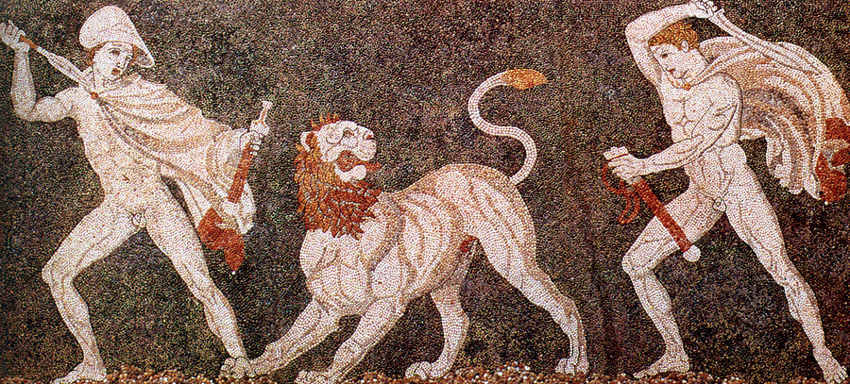
Craterus
Iakovos Garivaldis OAM
One of Alexander the Great’s Ablest Commanders
This time we consider the contribution of one of the most trusted and capable High Commanders in Alexander the Great’s army who actually lead the phalanx into battle. What is the etymology if his name in Ancient Greek, let’s find out…
Etymology
The name Craterus (Κρατερός, Kraterós) derives directly from the Greek adjective κρατερός, meaning “strong,” “mighty,” or “powerful” — a word used frequently in Homeric epic to describe great warriors and heroes in battle. It shares its root with κράτος (kratos, “power,” “strength,” “might”), the same element found in words like democracy (δημοκρατία, “rule of the people”) and aristocracy (ἀριστοκρατία, “rule of the best”). As a personal name, Κρατερός essentially means “the mighty one” or “the powerful one” — a fitting name for a commander whose military career was defined by strength, reliability, and staying power.
Craterus’ ability to lead large contingents of troops and maintain discipline was crucial in the success of Alexander’s extended campaigns.
Craterus was among the most capable and consistently trusted of Alexander the Great’s Macedonian officers, rising from cavalry command to become, alongside Hephaestion, one of the two most senior figures in the entire army by the campaign’s later years. Born around 370 BC, likely to a family of the Macedonian nobility from Orestis, he had already earned distinction under Philip II before Alexander’s accession, and his career across the Asian campaign reads as a steady climb through positions of ever-greater responsibility.
Craterus commanded infantry battalions with distinction at Issus and Gaugamela, and by the time of the eastern campaigns into Bactria, Sogdiana, and India, he had become one of Alexander’s most reliable independent commanders — regularly entrusted with detached forces to secure supply lines, subdue resistant regions, or guard the army’s rear while Alexander pressed forward with the more mobile strike force. He played a central role in the brutal Indian campaign, including the sieges of fortified towns and the difficult Gedrosian desert march, where his division took a safer inland route while Alexander’s suffered catastrophically along the coast.
He was renowned above all for his devotion to traditional Macedonian customs, standing in notable contrast to Hephaestion’s greater comfort with Alexander’s adoption of Persian dress and court practices. Ancient sources describe an open rivalry between the two men, though Alexander valued both — reportedly remarking that he loved Hephaestion as he loved Alexander, but he loved Craterus as he loved the king, a comment underscoring Craterus’s loyalty to Macedonian tradition and to Alexander’s authority itself.
In 324 BC, Alexander appointed Craterus to lead the veteran and disabled soldiers being discharged back to Macedonia, also entrusting him with delivering a controversial royal decree and effectively installing him as a check on the regent Antipater’s power. He was en route when Alexander died in Babylon in 323 BC. In the ensuing wars of succession, Craterus fought on Antipater’s side against the Greek uprising in the Lamian War, but he was killed in battle in 321 BC against Eumenes of Cardia in Asia Minor — one of the many casualties among Alexander’s inner circle as the empire fractured into competing successor kingdoms.
 Save as PDF