
Cleitus, Leonnatus, Aristonous
Iakovos Garivaldis OAM
We continue with Alexander the Great’s commanders, searching for ‘areti‘ (Αρετή = virtue+bravery+rightousness+…) in all of his officers. This time we examine Cleitus the Black to distinguish him from another, Leonnatus and Aristonous. All senior commanders.
Cleitus “the Black”
The name derives from the Greek root κλέος (kleos, “fame” or “glory”) — the same root behind words like Pericles (Περικλῆς, “surrounded by glory”) and Sophocles (Σοφοκλῆς, “famed for wisdom”). More precisely, Κλεῖτος is built on the adjective κλυτός (klytos, “renowned,” “famous,” “heard of”), itself from the verb κλύω (klyō, “to hear,” “to be spoken of”). So the underlying sense is something like “the renowned one” or “the one who is heard of / famed.” His epithet Μέλας (Melas) simply means “black” or “dark” — likely referring to his complexion or hair.
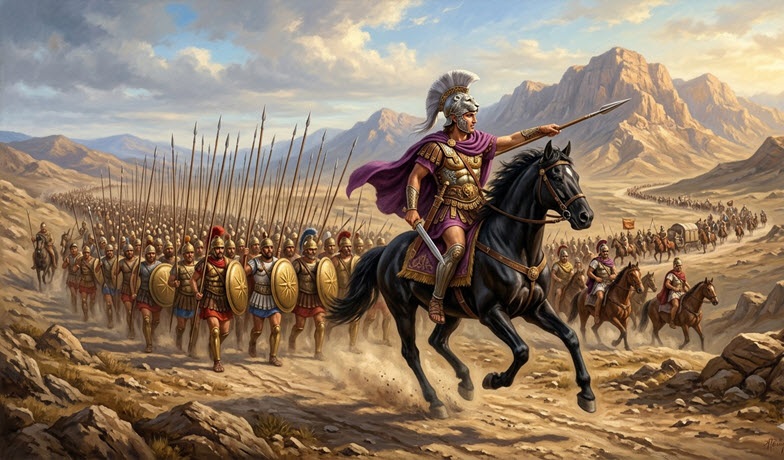
Cleitus, nicknamed “the Black” (Cleitus Melas) to distinguish him from another officer, “Cleitus the White,” was one of Alexander’s most senior and trusted cavalry commanders, having served under Philip II before him. His sister, Lanice, had been Alexander’s childhood nurse, giving him a personal bond with the king that went back decades. Cleitus commanded the elite Companion cavalry and, most famously, saved Alexander’s life at the Battle of the Granicus in 334 BC, cutting down a Persian noble who was about to strike the king from behind. He was later given joint command of the Companion cavalry alongside Hephaestion. Cleitus met a tragic end at Samarkand in 328 BC: during a drunken banquet, he openly criticized Alexander’s growing adoption of Persian customs and his diminishing regard for Macedonian tradition and his father Philip’s achievements. Enraged, Alexander killed him on the spot with a spear, an act he reportedly regretted deeply afterward. Cleitus’s death is often cited by historians as a turning point illustrating the corrosive effects of Alexander’s increasing autocracy and cultural drift.
Leonnatus
This one is trickier, and worth being upfront that its etymology is somewhat uncertain — it’s a Macedonian name, and Macedonian naming conventions and dialect sometimes diverge from standard Attic Greek, making precise derivations harder to pin down with confidence. The first element is clearly λέων (leōn, “lion”), a very common root in Greek names denoting strength or nobility (as in Leonidas). The second element, -νᾱτος, is generally connected to a root meaning “born” — related to forms like γνητός (gnētos, “born,” “kin,” from the verb γίγνομαι, “to be born” or “to become”). Under that reading, Leonnatus would mean something close to “lion-born” — i.e., of lion-like stock or lineage, a fitting name for a Macedonian nobleman connected to the royal house.
Leonnatus was a Macedonian nobleman and one of Alexander’s most prominent bodyguards (Somatophylakes), reputedly related to the royal house through Alexander’s mother, Olympias. He served with distinction throughout the campaign, notably saving Alexander’s life during the siege of the Mallian town in India in 325 BC, when the king was gravely wounded after leaping into the enemy citadel alone. Leonnatus fought his way in to defend him, an act for which he was later honored. He also played a key role at the Battle of Gaugamela and was entrusted with important administrative duties, including overseeing the Persian queen mother Sisygambis after the Persian royal family was captured following Issus. Following Alexander’s death in 323 BC, Leonnatus was among the officers who received a satrapy in the subsequent division of the empire, taking control of Hellespontine Phrygia. He was ambitious and reportedly aspired to greater power, at one point receiving a request for aid from Alexander’s sister Cleopatra. He died in 322 BC at the Battle of Lamia, fighting alongside Antipater against a Greek uprising in the Lamian War, one of the earlier casualties among Alexander’s inner circle during the wars of succession.
Aristonous (Άριστος + Νους)
This one is the most transparent of the three, following a very standard Greek compounding pattern. It combines ἄριστος (aristos, “best,” the superlative of ἀγαθός, “good”) — the same root as in Aristotle (“best purpose/end”) and aristocracy (“rule of the best”) — with νόος / νοῦς (noos/nous, “mind,” “intellect,” “understanding”). Together, Ἀριστόνους means roughly “best-minded” or “of the finest understanding/judgment” — a name that projects wisdom and sound judgment, qualities well suited to a trusted royal bodyguard.
Aristonous was another of Alexander’s seven Somatophylakes, the elite royal bodyguards responsible for the king’s personal protection, and he served in this role for a significant portion of the eastern campaign. Though he appears less frequently in surviving sources than figures like Hephaestion or Ptolemy, he was clearly a trusted and senior officer, present at major moments including the aftermath of Alexander’s near-fatal wound in India, and he is recorded as one of the officers who stood by the king’s side during his final illness in Babylon in 323 BC. After Alexander’s death, Aristonous was one of the officers involved in the tense negotiations over succession, initially supporting the claims of Alexander’s unborn child (later Alexander IV) alongside the infantry’s favored candidate, Philip Arrhidaeus. He was later granted a role in Macedonia itself under the regency structure. His fortunes eventually became entangled with Olympias, Alexander’s formidable mother, whom he supported during the brutal succession conflicts; when her cause collapsed, Aristonous was killed around 317–316 BC, a casualty of the wider power struggles that consumed Alexander’s former inner circle in the decades after his death.
 Save as PDF