
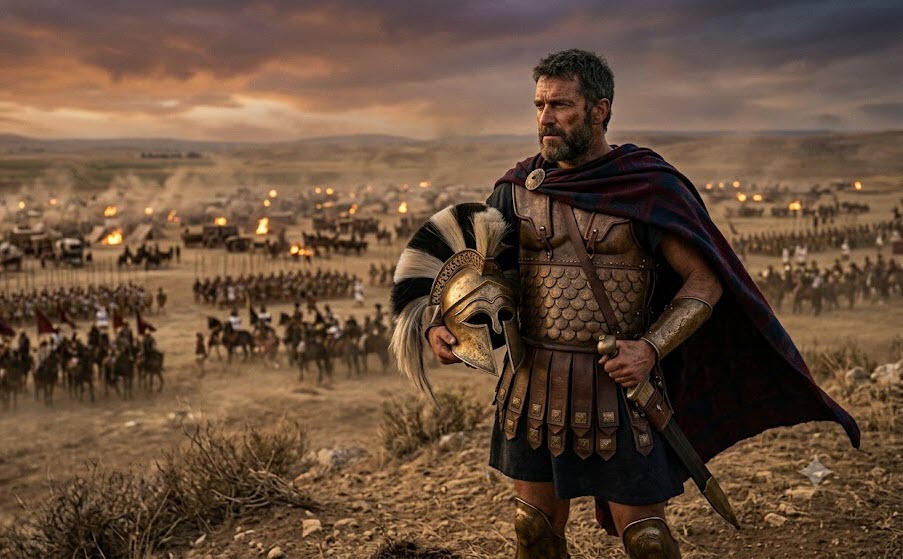
Black Cleomenes, Leonnatus, Aristonous — Bodyguards and officers
Iakovos Garivaldis OAM
Once more, we continue analysing the lives and achievements of three bodyguards and high ranked officers in Alexander the Great’s army that conquered Asia Minor, the Persian Empire, even India before he faced a revolt within his army who were getting tired and missed their families back home. Very interesting stories of struggle, bravery and survival of the fittest.
Cleomenes of Naucratis (Κλεομένης ὁ Nαυκρατίτης)
Etymology: Kleomenēs (Κλεομένης) is a compound of two familiar Greek roots. The first, κλέος (kleos, “fame,” “glory”), is the same element found in names like Pericles and Sophocles, and indeed in Cleitus’s name. The second, μένος (menos, “might,” “strength,” “spirit” or “wrath” — a word closely tied to vital force and battle-fury, as used of warriors in Homer), combines with it to produce a sense of “famed for might” or “glory of strength.” His epithet, Ναυκρατίτης (Naukratitēs), simply denotes his origin from Ναύκρατις (Naukratis), an ancient Greek trading city in the Nile Delta — itself a compound of ναῦς (naus, “ship”) and κράτος (kratos, “power,” “rule”), so the city’s own name means roughly “ship-power” or “naval might,” reflecting its origins as a major Greek maritime trading post in Egypt.
Cleomenes was a Greek from Naucratis in Egypt who rose to become one of Alexander’s most powerful administrators, though his role sat apart from the campaigning bodyguards and cavalry officers — he was primarily a financial and provincial governor rather than a battlefield commander. After Alexander conquered Egypt in 332 BC, he appointed Cleomenes as satrap, or in some accounts as the chief financial official overseeing Egypt’s nomarchs, giving him effective control over the country’s vast revenues, including the newly founded city of Alexandria’s early administration and taxation. Cleomenes proved a shrewd and often ruthless economic operator: ancient sources, particularly Pseudo-Aristotle’s Oeconomica and Arrian, describe him exploiting a regional famine to corner the grain market, manipulating export policy to inflate prices and profit personally, and using various extortionate schemes against Egyptian priests and officials to extract wealth.
Despite — or perhaps because of — this reputation for corruption, Alexander appears to have tolerated him due to the sheer scale of revenue he funneled back to the crown. After Alexander’s death in 323 BC, Cleomenes was retained as deputy to the newly appointed satrap Ptolemy (soon to become Ptolemy I Soter). Ptolemy, wary of Cleomenes’ independent financial power and loyalty, had him executed shortly afterward, consolidating his own control over Egypt at the very start of what would become the Ptolemaic dynasty.
Leonnatus (Λεοννάτος)
Etymology: This name is somewhat uncertain, being Macedonian rather than standard Attic Greek, which sometimes complicates precise derivation. The first element is clearly λέων (leōn, “lion”), a common root in Greek names denoting strength or nobility (as in Leonidas). The second element, -νᾱτος, is generally connected to a root meaning “born,” related to forms like γνητός (gnētos, “born,” “kin,” from γίγνομαι, “to be born”). Under this reading, Leonnatus means roughly “lion-born” — of lion-like stock or lineage.
Leonnatus was a Macedonian nobleman and one of Alexander’s most prominent bodyguards (Somatophylakes), reputedly related to the royal house through Alexander’s mother, Olympias. He served with distinction throughout the campaign, notably saving Alexander’s life during the siege of the Mallian town in India in 325 BC, when the king was gravely wounded after leaping into the enemy citadel alone. Leonnatus fought his way in to defend him, an act for which he was later honored. He also played a key role at the Battle of Gaugamela and was entrusted with important administrative duties, including overseeing the Persian queen mother Sisygambis after the Persian royal family was captured following Issus.
Following Alexander’s death in 323 BC, Leonnatus was among the officers who received a satrapy in the subsequent division of the empire, taking control of Hellespontine Phrygia. Ambitious and reportedly aspiring to greater power, he at one point received a request for aid from Alexander’s sister Cleopatra. He died in 322 BC at the Battle of Lamia, fighting alongside Antipater against a Greek uprising in the Lamian War — one of the earliest casualties among Alexander’s inner circle during the wars of succession.
Aristonous (Ἀριστόνους)
Etymology: The most transparent of the three, following a standard Greek compounding pattern. It combines ἄριστος (aristos, “best,” the superlative of ἀγαθός, “good”) — the same root as in Aristotle and aristocracy — with νόος / νοῦς (noos/nous, “mind,” “intellect”). Together, Ἀριστόνους means roughly “best-minded” or “of the finest judgment” — a fitting name for a trusted royal bodyguard.
Aristonous was another of Alexander’s seven Somatophylakes (σώμα + φύλακας = bodyguard), the elite royal bodyguards responsible for the king’s personal protection, serving in this role for a significant portion of the eastern campaign. Though he appears less frequently in surviving sources than figures like Hephaestion or Ptolemy, he was clearly a trusted and senior officer, present at major moments including the aftermath of Alexander’s near-fatal wound in India, and recorded as one of the officers who stood by the king’s side during his final illness in Babylon in 323 BC. After Alexander’s death, Aristonous was involved in the tense negotiations over succession, initially supporting the claims of Alexander’s unborn child (later Alexander IV) alongside the infantry’s favored candidate, Philip Arrhidaeus.
He was later granted a role in Macedonia itself under the regency structure. His fortunes eventually became entangled with Olympias, Alexander’s formidable mother, whom he supported during the brutal succession conflicts; when her cause collapsed, Aristonous was killed around 317–316 BC, a casualty of the wider power struggles that consumed Alexander’s former inner circle in the decades after his death.
 Save as PDF