
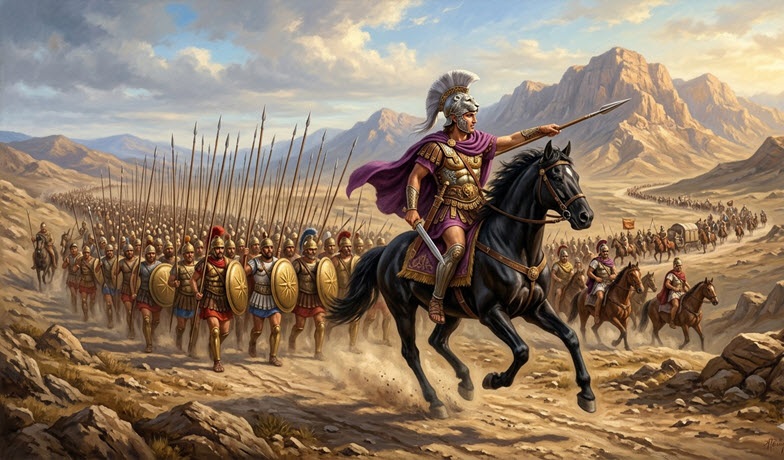
Coenus and Meleager
Iakovos Garivaldis OAM
We take another look at the army of Alexander the Great with two of his most trusted infantry commanders that helped him tremendously in his campaign, even after reaching India and the Hyphasis (Beas) River. After defeating King Porus at the Battle of the Hydaspes (Wikipedia) (modern Jhelum River), Alexander wanted to push further east toward the Ganges River and the powerful Nanda Empire. When his army reached the banks of the Hyphasis, the soldiers balked at facing rumored massive Indian armies and torrential seasonal monsoons. The troops staged the famous Hyphasis Mutiny, refusing to take another step forward. Alexander built massive altars on the western bank to mark the eastern boundary of his empire and founded a settlement named Alexandria on the Hyphasis before turning back south along the Indus Valley.
Coenus: The Tactical Vanguard
Coenus (Κοινός), son of Polemocrates (Πολεμοκράτης), was one of Alexander the Great’s most trusted and capable infantry commanders. Leading an elite battalion (taxis) of the heavy phalanx, he distinguished himself through supreme tactical reliability and battlefield grit. At the Battle of Issus and the Siege of Tyre, Coenus’ heavily armed troops formed the bedrock of the Macedonian line. His finest tactical hour arrived at the Battle of the Hydaspes in 326 BC. Facing King Porus’ terrifying war elephants, Alexander deployed Coenus in a critical flanking maneuver. Coenus led his infantry and coordinated cavalry around the Indian right wing, striking the enemy forces from the rear. This decisive, synchronized intervention shattered the Indian formations, securing a brutal but complete Macedonian victory.
The Speech at the Hyphasis River
Following the trauma of the Hydaspes, the weary army marched further east to the Hyphasis River (the modern Beas River). Rumours of massive adversarial armies, millions of hostile warriors, and thousands of war elephants waiting across the Ganges pushed the exhausted soldiers to the brink of mutiny. Alexander, furious at their sudden defiance, called an assembly and demanded they press onward into the unknown. In this incredibly tense standoff, where other generals remained silent out of fear, Coenus stepped forward as the brave voice of the rank-and-file.
Coenus spoke to his king with profound reverence but uncompromising honesty. He acknowledged Alexander’s unmatched genius and divinely inspired victories, but he firmly urged him to recognize human limitations. “A brave general,” Coenus argued, “knows when to stop.” He pointed to the hollow eyes of the veterans gathered around them, noting that their weapons were blunted, their armor was rusted, their clothes were in rags, and their bodies were entirely broken by countless campaigns. He emphasized that the men did not lack loyalty to the crown, but rather the sheer physical capacity to endure more hardship. They longed to return home to see their aging parents, their wives, and their children, and to finally enjoy the immense wealth and spoils of their unprecedented victories. Coenus concluded that a noble leader should command willing men, not broken spirits, and that returning to Greece would allow Alexander to recruit a fresh, eager generation to conquer the remaining world. His emotional words broke the tension, moving the entire army to tears and forcing Alexander to finally turn back. Tragically, Coenus died of a sudden illness shortly after.
Meleager: The Phalanx Traditionalist
Meleager, son of Neoptolemus, commanded another pivotal phalanx battalion during the Asiatic campaign. He fought bravely from the Granicus to Gaugamela, representing the conservative bedrock of the Macedonian infantry. Unlike Coenus, who balanced tactical genius with political diplomacy, Meleager was a rigid traditionalist. He grew increasingly resentful of Alexander’s adoption of Persian customs and the integration of Eastern soldiers into the army. This friction culminated after Alexander’s death in 323 BC.
During the chaotic succession crisis in Babylon, Meleager championed the rights of the ordinary Macedonian infantry against the aristocratic cavalry led by Perdiccas. He backed the mentally disabled Philip III Arrhidaeus for the throne, briefly sparking a civil standoff. However, Meleager lacked strategic foresight; Perdiccas outmaneuvered him, and Meleager was ultimately executed, ending the career of a fierce but politically volatile commander.
The word in Greek for Meleager is Μελέαγρος with this etymology:
- μέλει (mélei): A verb meaning “to care for”, “to be an object of anxiety”, or “to trouble”.
- ἄγρα (ágra): A noun meaning “the hunt”, “the prey”, or “the chase”.
 Save as PDF