
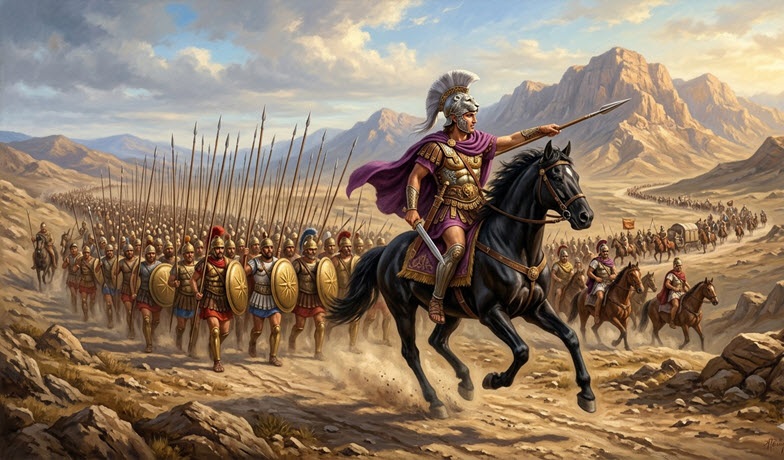
Menidas, Aretes, Demetrius — Cavalry
Iakovos Garivaldis OAM
We continue with the three squadron commanders in Alexander’s army who were crucial in the victory over at Gaugamela, a wide plain near modern-day Tel Gomel in northern Iraq (northeast of Nineveh and Mosul). It was the second and final major clash between Alexander the Great of Macedon and King Darius III which decided the Greco-Persian war.
Menidas (Μηνίδας)
Menidas commanded the Greek mercenary cavalry at Gaugamela in 331 BC, a unit distinct from the Macedonian Companion cavalry and positioned in a critical, mobile role on the battlefield.
According to Arrian, Menidas’s mercenary horsemen were posted in advance of the main line, with explicit orders to wheel around and strike the Persian flank if Darius’s forces attempted an encircling maneuver — a tactically demanding assignment that speaks to the trust placed in him. When the battle unfolded, Menidas charged the Scythian and Bactrian cavalry screening the Persian left, but his smaller mercenary force was driven back by their sheer numbers; Alexander responded by sending reinforcements under Ariston to restore the position. Despite this initial setback, Menidas’s engagement played an important tactical role, helping to draw off a significant portion of Darius’s cavalry strength at a crucial moment, contributing to the opening that Alexander needed elsewhere on the field. Beyond Gaugamela, Menidas appears intermittently in the sources as a trusted mercenary cavalry officer through the following years of campaigning.
Etymology: The root of Mēnidas is less certain than most Macedonian officer names, and scholars have offered more than one explanation. One possibility ties it to μήν/μήνη (mēn/mēnē, “month” or “moon”), possibly a theophoric name referencing Men, a widely worshipped lunar deity across Anatolia and Asia Minor — plausible given the frequent cultural and onomastic overlap between Macedon and the wider Eastern Mediterranean and Anatolian world. An alternative reading connects it to μένος (menos, “might,” “spirit,” “battle-fury”) — the same root behind Cleomenes — which would render the name as something closer to “of vigor” or “of spirit.” The -ίδας ending is a common Doric/Macedonian patronymic-style suffix, roughly equivalent to “son of.”
Aretes (Ἀρέτης)
Aretes commanded the sarissophoroi (also called the prodromoi), an elite unit of Macedonian lancer-scouts prized for their versatility — skilled at reconnaissance and screening the army’s movements, but equally capable of decisive close-quarters combat when needed. He had taken over this command from an earlier officer, Protomachus, prior to Gaugamela.
In the battle, Aretes was entrusted with Alexander’s last cavalry reserve, and his charge proved pivotal: his lancers broke the heavy Massagetae cavalry in a climactic engagement on the flank, with Aretes reportedly killing their commander in personal combat. This action helped rout the Persian left wing’s cavalry entirely, a decisive contribution to the collapse of that section of Darius’s line and, by extension, to the wider Macedonian victory. Aretes exemplifies the kind of hard-driving, front-line cavalry leadership that characterized Alexander’s mid-tier officer corps — men whose battlefield initiative repeatedly turned tactical opportunities into full-blown routs.
Etymology: Aretēs (Ἀρέτης, also rendered Ἀρέτας) derives from ἀρετή (aretē), one of the most resonant words in the Greek moral and martial vocabulary — meaning “excellence,” “virtue,” or “valor,” particularly the kind of excellence proper to a warrior or a man of noble character in the Homeric and classical tradition. A name built on this root essentially proclaims its bearer “the excellent one” or “the valorous one” — a fitting name, whether by birth or by reputation, for an officer whose signature moment was a killing blow that broke an enemy cavalry line.
Demetrius, son of Althaemenes (Δημήτριος)
Demetrius commanded one of the elite squadrons (ilai) of Companion cavalry at Gaugamela, positioned in the battle line among fellow squadron commanders Glaucias, Ariston, Sopolis, Heraclides, Meleager, and Hegelochus, all under the overall cavalry command of Philotas, son of Parmenion.
As a Companion cavalry squadron leader, he held one of the most prestigious mid-level commands in Alexander’s entire army — the Companions were the elite heavy cavalry arm that delivered Alexander’s decisive strikes in nearly every major battle, and squadron command was reserved for proven, high-trust officers drawn from Macedonian nobility. Beyond his listed position in Arrian’s battle order at Gaugamela, Demetrius is a comparatively obscure figure in the surviving sources relative to more prominent names like Cleitus or Hephaestion — a reminder that Alexander’s campaigns were sustained not only by the famous inner circle but by a wider bench of capable, lesser-recorded squadron commanders whose steady competence made the army’s larger tactical successes possible.
Etymology: Dēmētrios (Δημήτριος) is a theophoric name — one of the most common in the entire Greek world — meaning “belonging to” or “devoted to Demeter,” the goddess of agriculture, grain, and the harvest. It’s formed directly from the goddess’s name, Δημήτηρ (Dēmētēr, itself likely a compound relating to “mother” and possibly “earth” or “grain,” though her own etymology is debated among linguists), with the adjectival suffix -ιος marking association or devotion. The name’s popularity persisted well beyond Alexander’s era, most famously later borne by Demetrius I Poliorcetes, one of the most flamboyant of the Successor kings.
 Save as PDF