
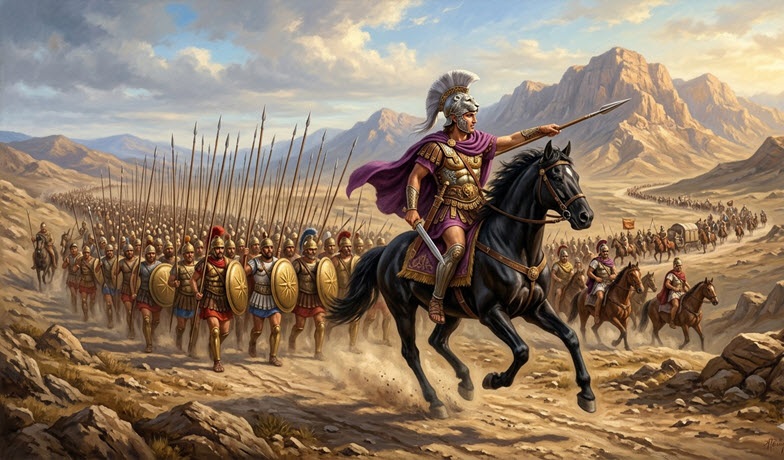
Persia and Alexander
Alexander’s campaign wasn’t just a military conquest; it was essentially the world’s first massive cultural “rebrand.” He didn’t just want to rule Persia; he wanted to fuse it with Greece to create a singular, Greco-Persian superpower.
Here is an overview of how Alexander the Great bridged the gap between East and West.
The Sword and the Scroll: Taking Greece to the East
When Alexander crossed the Hellespont in 334 BCE, he carried the Iliad under his pillow, but he brought more than just epic poetry. As he dismantled the Achaemenid Empire, he began a process known as Hellenization.
- Founding the “Alexandrias”: Alexander founded dozens of cities across his new empire (most of them named after himself). These were built on the Greek model, featuring agoras (marketplaces), gymnasiums, and theaters.
- The Koine Language: Greek became the lingua franca—the common language of administration and trade—which allowed a philosopher in Athens to eventually communicate with a merchant in what is now Afghanistan.
The Acceptance of Hellenism
One of Alexander’s most brilliant (and controversial) moves was his refusal to treat the Persians as a “conquered” or “barbarian” people. Instead, he adopted Persian customs to signal that he was their legitimate successor.
- Persian Court Etiquette: Alexander began wearing Persian royal clothing and adopted the practice of proskynesis (ritual bowing). While this annoyed his Macedonian generals, it made him much more palatable to the Persian nobility.
- Cultural Syncretism: The Persians didn’t just tolerate Greek culture; they integrated it. This led to Greco-Bactrian art, where Greek artistic techniques (like realistic musculature in statues) were used to depict local Eastern themes.
The Policy of Fusion: The Susa Weddings
Alexander’s most radical attempt at cultural unity happened in 324 BCE at the Susa Weddings. He realized that for his empire to survive his death, the bloodlines of the two civilizations had to mix.
Alexander didn’t just want his soldiers to be an occupying force; he wanted them to be family.
- The Mass Wedding: Alexander arranged for 80 of his high-ranking officers to marry noble Persian women. He himself took two Persian brides: Stateira (daughter of Darius III) and Parysatis.
- The Troops: Beyond the elite, Alexander encouraged his common soldiers—around 10,000 of them—to legitimize their relationships with local women. He even paid off their debts as a wedding gift.
- The Goal: He hoped the children of these unions would be a new race of “Macedonian-Persians” who owed loyalty to the empire rather than a specific city-state.
A Lasting, Hybrid Legacy
Though the empire fractured almost immediately after Alexander’s death in 323 BCE, the cultural “genie” was out of the bottle. This era—the Hellenistic Period—saw Greek influence stretch all the way to India.
The Persians kept their administrative structures, but the Greek language and art remained the “software” that ran the Silk Road for centuries. Alexander’s dream of a unified people didn’t quite materialize as a single government, but it did create a globalized world where East and West were no longer strangers.
The “Susa Weddings” were actually quite controversial among the Macedonian soldiers who felt Alexander was “going too Persian.” Do you think Alexander’s push for cultural fusion was driven more by a genuine belief in equality, or was it just a clever political tactic to keep the Persians from rebelling?
 Save as PDF