
Philotas and Antipater
Iakovos Garivaldis OAM
We continue with the commanders of Alexander the Great’s expedition to the East of Macedonia with two very important persons in his senior camp.
PHILOTAS (c. 360 – 330 BC)
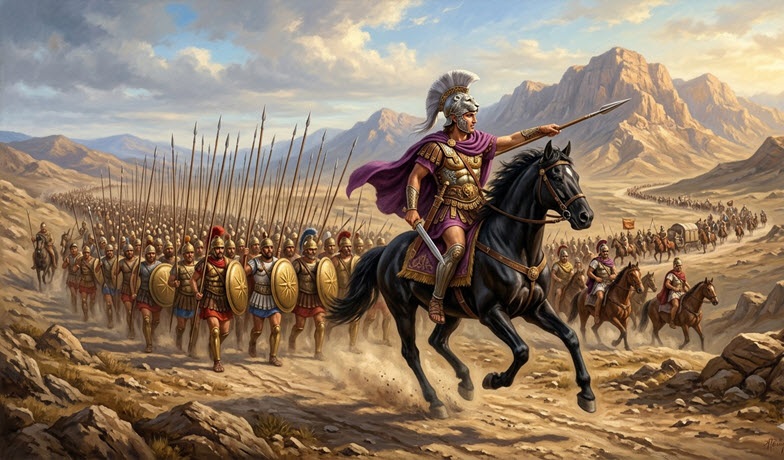
Philotas was the son of Parmenion (see previous articles about Parmenion), Alexander’s most senior general, and commanded the elite Companion Calvary – the most prestigious battlefield role in the Macedonian army. His appointment was essentially inherited through his father’s immense influence, though he proved a capable officer in his own right.
He fought with distinction at the Granicus (334 BC), Issus (333 BC), and Gaugamela (331 BC), where the Companion Calvary delivered the decisive charge that broke Darius III’s line. He was effective in battle, brave, and respected by the men he led.
However, Philotas was also arrogant, boastful, and politically careless. He allegedly knew of a plot against Alexander and failed to report it – a fatal mistake. In 330 BC at Phrata (in Drangiana), he was accused of conspiracy, tortured under interrogation, and executed. Almost simultaneously, Alexander had Parmenion – who was commanding rear forces at Ecbatana – assassinated, fearing he would seek revenge. The simultaneous elimination of father and son was cold political calculation.
His cavalry command passed to Hephaestion and Cleitus the Black, jointly – Alexander ensuring no single man again held such concentrated loyalty and power.
ANTIPATER (c. 397 – 319 BC)
Antipater was one of the most experienced statesmen and soldiers in Macedon, having served Phillip II loyally for decades before Alexander inherited him. Alexander trusted him enough to leave him as regent of Macedon and Greece – an enormous responsibility covering the entire European base of operations while the king campaigned in Asia.
He never joined the eastern expedition personally, but his role was indispensable. He crushed the Spartan king Agis IIs revolt at the Battle of Megalopolis (331 BC), a serious challenge to Macedonia supremacy in Greece that could have destabilized Alexander’s rear. He managed restless Greek city-states and kept the manpower pipeline flowing eastward to Alexander.
Relations with Alexander deteriorated in later years, partly due to friction with Alexander’s mother Olympias, who despised Antipater and lobbied against him. Alexander reportedly summoned him to Asia shortly before his own death in 323 BC – a summons Antipater likely recognized as potentially fatal.
After Alexander died, Antipater emerged as one of the dominant figures in the Wars of the Diadochi (Διάδοχοι – Successors). He died of old age in 319 BC in Macedon – one of the very few senior commanders to do so. His son Cassander went on to seize Macedon, famously executing Alexander’s mother Olympias and eventually Alexander’s own son, effectively ending the Argead dynasty.
 Save as PDF