
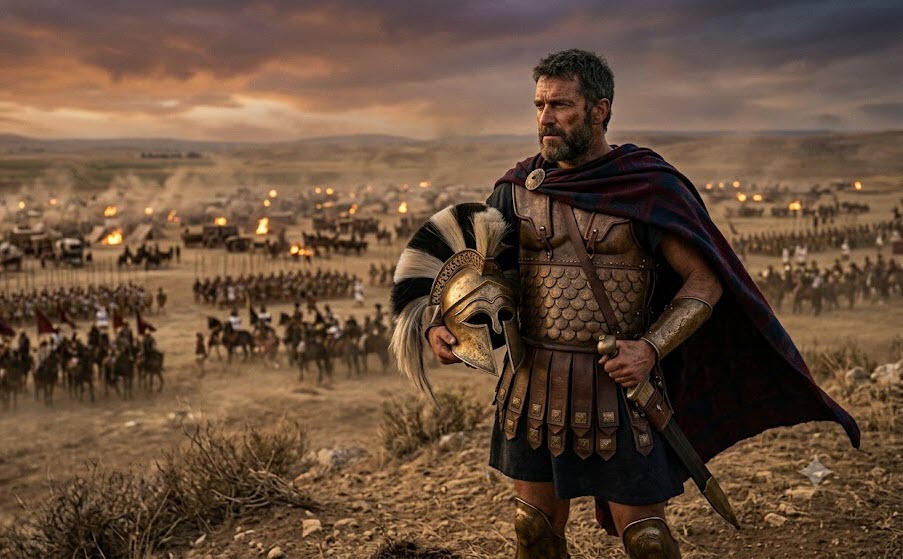
Parmenion, Craterus, Perdiccas
Three Exceptional Guards
Iakovos Garivaldis OAM
The legacy of Alexander the Great is inextricably linked to the brilliant military minds who rode alongside him. Among the most influential of these Companions were Parmenion (Παρμενίων = he who remains vigilant, patient and constant), Craterus (Κρατερός = strong, powerful), and Perdiccas (Περδίκκας = fast and flexible)—three distinct commanders whose strategic brilliance, battlefield valor, and political ambitions helped forge one of the largest empires in history, only for them to be caught in the turbulent wake of its collapse.
Parmenion: The Iron Foundation
Parmenion was the old guard of the Macedonian military machinery, a seasoned general who had already served Philip II with immense distinction before Alexander even ascended the throne. When Alexander launched his Asian campaign, Parmenion was trusted as his second-in-command, typically anchoring the critical left flank of the army. At the battles of Granicus, Issus, and Gaugamela, Parmenion’s role was to hold the line against overwhelming Persian numbers, absorbing the enemy’s heaviest assaults while Alexander led the decisive cavalry charge on the right.
Parmenion’s cautious, methodical strategic approach often clashed with Alexander’s reckless genius, yet his reliable defense was the anchor that allowed Alexander’s offensive victories to happen. His tragic end highlighted the brutal nature of Macedonian court politics; following a failed conspiracy plot involving his son Philotas, Alexander ordered Parmenion’s assassination in 330 BCE to prevent a potential rebellion, cutting down the army’s most loyal foundational pillar.
Craterus: The Beloved Soldier
If Parmenion represented the old guard, Craterus represented the pinnacle of battlefield leadership under Alexander. He rose rapidly through the ranks to become one of Alexander’s most trusted and capable independent commanders. Known for his deep loyalty to Macedonian traditions, Craterus was fiercely protective of his men, making him arguably the most popular general among the common infantry.
Craterus led the phalanx with devastating efficiency and was frequently trusted with large, independent detachments during the arduous campaigns in Bactria and India. When Alexander began integrating Persian customs into his court—a move that deeply alienated his veterans—Craterus remained an outspoken champion of traditional Macedonian culture. Before Alexander’s death, Craterus was tasked with leading 10,000 veteran soldiers back to Europe, cementing his position as a guardian of the homeland.
Perdiccas: The Imperial Regent
Perdiccas was a commander of exceptional martial prowess who famously commanded the heavy phalanx battalion and served as a close bodyguard (Somatophylax) to Alexander. He distinguished himself during the grueling siege of Thebes and the Indian campaign, eventually rising to become Alexander’s closest confidant after the death of Hephaestion. In his final moments, Alexander allegedly handed his royal signet ring to Perdiccas, effectively thrusting him into the center of the civilized world.
Following Alexander’s sudden death in 323 BCE, Perdiccas was appointed Regent of the Empire. Attempting to hold the vast realm together in the names of Alexander’s disabled half-brother and unborn son, Perdiccas wielded immense centralized power. However, his authoritarian approach sparked the Wars of the Diadochi (Successors). His ambition ultimately outpaced his political survival; during a disastrous campaign against Ptolemy in Egypt, Perdiccas was mutinied against and assassinated by his own officers in 321 BCE.
Shared Legacy
Together, these three commanders illustrated the multi-faceted nature of Alexander’s campaigns. Parmenion provided the essential strategic framework, Craterus embodied the fierce loyalty and martial spirit of the troops, and Perdiccas represented the sweeping, tragic political ambitions that defined the post-Alexandrian world. While they ultimately turned on one another or fell victim to paranoia, their combined successes permanently reshaped the geopolitics of the ancient Mediterranean.
Subscribe to our Newsletter
 Save as PDF