
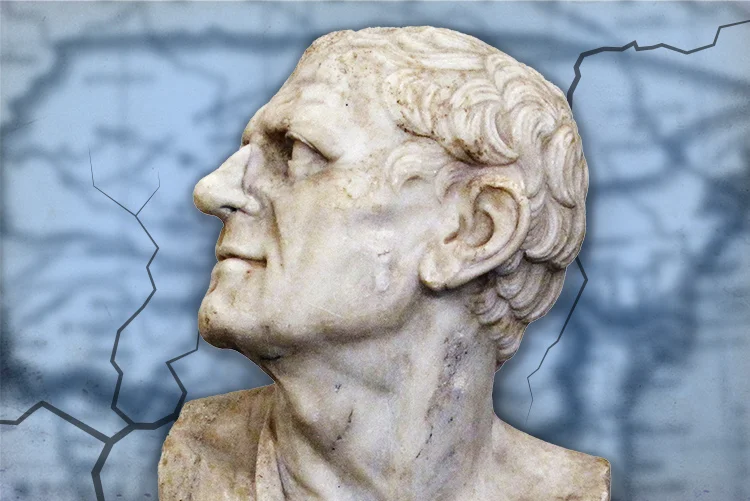
Ptolemy and Lysimachus
Iakovos Garivaldis OAM
Continuing with the most important commanders and officers of Alexander the Great’s army which conquered the known world we are examining the lives of two more of his close companions that later became rulers of different parts of his empire. Intriguing stories that affected millions of people and so many countries to the east.
Two Companions of Alexander: Ptolemy and Lysimachus
Among the brilliant constellation of officers who served Alexander the Great, two figures stand out not only for their loyalty during his campaigns but for the extraordinary kingdoms they carved from his shattered empire: Ptolemy, son of Lagus, and Lysimachus of Pella.
PTOLEMY
(Ancient Greek etymology: “πτόλεμος/πόλεμος = warlike”)
Ptolemy was arguably the most astute of Alexander’s companions. Possibly an illegitimate son of Philip II — a claim he may have cultivated — he grew up in the Macedonian court and developed a sharp political intelligence that complemented his military talent. He served Alexander faithfully across Persia, Central Asia, and India, earning command of the royal bodyguard. When Alexander died in Babylon in 323 BC, Ptolemy moved with characteristic decisiveness. He secured Egypt as his satrapy, and in a bold stroke of political theatre, hijacked Alexander’s funeral cortège and brought the conqueror’s body to Alexandria, where its presence would lend his dynasty divine legitimacy.
He declared himself king in 305 BC, founding the Ptolemaic dynasty that would rule Egypt for nearly three centuries — ending only with Cleopatra VII in 30 BC. A man of genuine intellectual curiosity, Ptolemy also wrote a celebrated firsthand history of Alexander’s campaigns, now lost but preserved through Arrian. He founded the great Library of Alexandria and the Mouseion, making his court a beacon of Hellenistic scholarship. He died peacefully in 283 BC, aged around eighty-four — a rare fate among the Successors.
LYSIMACHUS
(Ancient Greek etymology: “λύσις + μάχη = dispersing in battle”)
Lysimachus was a different temperament entirely: a soldier of physical courage and fierce tenacity. He had served as one of Alexander’s personal bodyguards — a position of enormous trust — and distinguished himself in combat repeatedly during the Indian campaign. After Alexander’s death, he received Thrace as his domain, a volatile frontier region requiring constant military vigilance against the Odrysian tribes and the powerful kingdom of the Getae. In 292 BC he suffered one of the great humiliations of the age, captured by the Getian king Dromichaetes, though he was eventually released. He built his power steadily, crossing into Asia Minor and eventually controlling much of western Anatolia.
His most dramatic moment came at the Battle of Ipsus in 301 BC, where his war elephants proved decisive in defeating and killing Antigonus the One-Eyed. At his peak he ruled Thrace, Asia Minor, and Macedon itself. Yet his end was violent. He executed his own son Agathocles on the suspicion of treason — a decision that shattered loyalties — and was killed at the Battle of Corupedium in 281 BC, fighting Seleucus I. He was perhaps eighty years old, dying sword in hand.
Together, their lives trace the full arc of the Hellenistic age: one man who built wisely and endured; another who grasped brilliantly and fell.
 Save as PDF